



Heliocol solar pool heating is sized by total collector area compared with your pool’s water surface area. That’s why we manufacture Heliocol in six panel sizes, to suit every roof shape and size. Our starting point is 80% coverage, in line with the industry minimum, and the final recommendation is adjusted for your location, roof layout and swimming expectations.
For example, an 8 × 4 m pool has a surface area of 32 m². Six HC50 panels provide 27.72 m² of collector area, or about 87% coverage. Seven provide 32.34 m², or about 101%. The right choice depends on the property and how you want to use the pool.
Heliocol is made by Magen eco-Energy, and Magen eco-Energy Australia supplies it through our dealer and installer network. We design each system around the pool and property, rather than recommending the same panel count for every home.
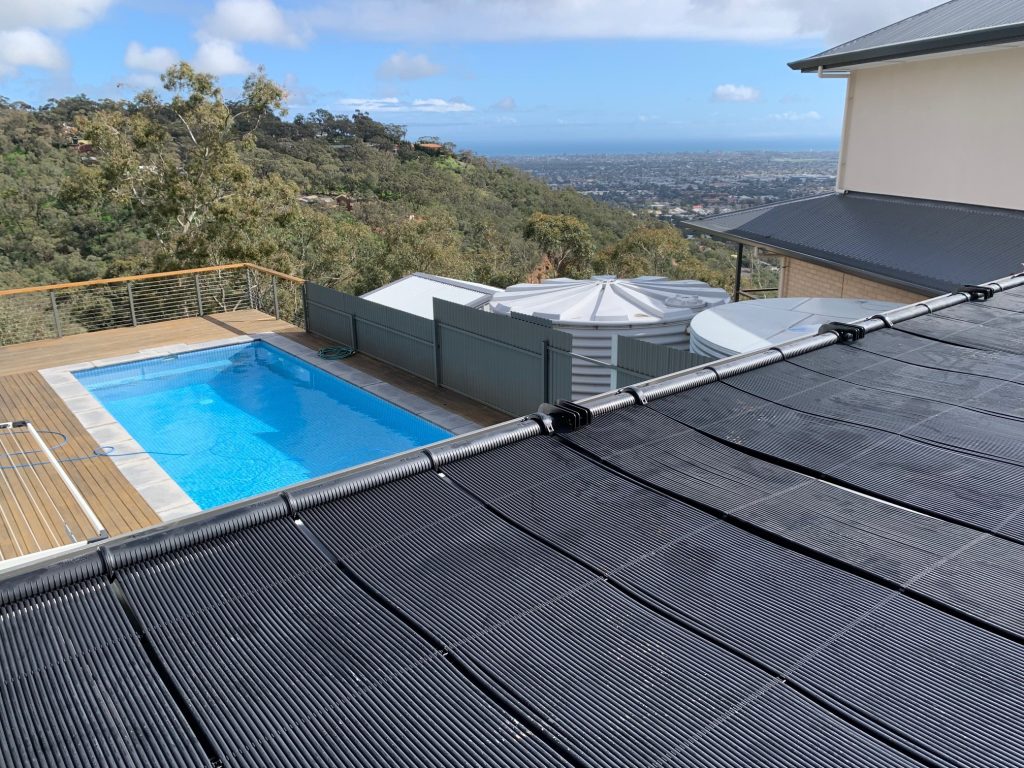
Pool water circulates through roof-mounted Heliocol collectors, absorbs heat from the sun and returns to the pool. These are solar thermal collectors, not photovoltaic panels that generate electricity.
The sun supplies the heating energy, while the pump uses electricity to circulate the water. Running costs therefore depend on the pump, system design and operating hours.
For a rectangular pool, multiply the water’s length by its width:
8 m × 4 m = 32 m²
Measure the water surface rather than the surrounding paving or coping. For an irregular pool, a pool plan or measured layout gives a more accurate area.
If you only know the volume, dividing litres by 1,500 gives a preliminary estimate, assuming an average depth of 1.5 m:
45,000 litres ÷ 1,500 = about 30 m²
This shortcut is less reliable for pools with extensive shallow ledges, unusual depths or large steps. Use the actual surface dimensions whenever you have them.
Coverage compares the total collector area with the pool’s surface area:
Collector area ÷ pool surface area × 100 = coverage percentage
For a 30 m² pool, 80% coverage means 24 m² of collector. At 100%, the collector area equals the pool surface area. Coverage describes the size of the system; it does not mean a particular percentage of the pool is heated.
80% is the industry minimum for most Australian pools. Australian Standard AS3634 suggests at least 60% of the pool’s surface, but only in ideal conditions, and on that basis SPASA recommends a minimum of 80% for the majority of installations [1].
We use 80% as the starting point. The final design accounts for local climate, roof orientation, shading, wind exposure, cover use and the swimming season you want. An 80% layout is the beginning of the assessment, not a promise that every pool reaches the same temperature or season.
For some properties, coverage around 100% or above is appropriate. Two sources back this. Magen has 43 years of experience engineering and installing Heliocol systems in every kind of climate around the world. CSIRO’s study of Australian pool temperatures modelled its solar-heated pools at exactly that ratio, with collector area equal to pool area, facing north [2]. A larger array is a design choice weighed against roof space, cost and expected benefit.
HC50 panels measure about 1.2 m × 3.85 m and provide 4.62 m² each. The table shows how many HC50 panels meet an 80% or 100% sizing reference, and the coverage that count actually delivers.
| Pool dimensions | Pool surface area | HC50 panels to meet 80% | Installed coverage | HC50 panels to meet 100% | Installed coverage |
|---|---|---|---|---|---|
| 5 × 2.5 m | 12.5 m² | 3 | 111% | 3 | 111% |
| 7 × 3.5 m | 24.5 m² | 5 | 94% | 6 | 113% |
| 8 × 4 m | 32 m² | 6 | 87% | 7 | 101% |
| 10 × 4 m | 40 m² | 7 | 81% | 9 | 104% |
| 10 × 5 m | 50 m² | 9 | 83% | 11 | 102% |
| 12 × 5 m | 60 m² | 11 | 85% | 13 | 100% |
Panel counts are rounded up; coverage is rounded to the nearest whole number. These are calculation examples, not final installation recommendations. A small pool does not need three HC50s just because that is the rounded result; smaller collectors may give a better layout.
| Pool volume | Approx. surface area | HC50 panels to meet 80% | Installed coverage |
|---|---|---|---|
| 30,000 L | 20 m² | 4 | 92% |
| 40,000 L | 26.7 m² | 5 | 87% |
| 50,000 L | 33.3 m² | 6 | 83% |
| 60,000 L | 40 m² | 7 | 81% |
These assume an average depth of 1.5 m. Allow a panel or two more for a cooler site or an east- or west-facing roof.
The best layout balances collector area with the space available for panels, mounting hardware and pipework.
A clear north-facing roof is generally preferred in Australia. East- and west-facing sections can also work, with the design adjusted for their solar exposure. Persistent shade should be considered carefully before choosing a roof section.
Heliocol’s range includes smaller panels for restricted roof areas. An HC15 measures about 1.2 m × 1.4 m and an HC26 about 1.2 m × 2.0 m. A smaller panel helps where a larger one would leave too little room for mounting and pipework.
Collectors can also be arranged in separate banks. That lets a system use suitable areas on more than one roof section, or work around solar electricity panels, skylights and other obstructions.
One of our team runs Heliocol on his own Sydney pool. The pool is 18 m², and the only usable roof faces west. He fitted nine panels: five HC38 and four HC15, giving 24.22 m² of collector, or 135% of the pool surface. That is high coverage on purpose. Tall trees along the northern boundary shade the house early and late in the season, just when solar heat matters most, so the extra collector area makes up for the lost sun.
Six HC50 panels placed side by side measure about 7.2 m wide × 3.85 m long. That is 27.72 m² before allowing for mounting hardware, pipework, roof edges and access.
A roof with 28 m² free will not automatically fit the array. Its shape and usable dimensions matter as much as its total area.
Heliocol can be designed for suitable metal, tile, flat and pitched roofs. Where the house roof is unsuitable, a carport, pergola or purpose-built ground mount may be worth assessing. Some installations can be mounted without roof penetrations; your installer confirms the right method for your property.
A cover keeps in the free heat your panels collect by day. Early and late in the season, when nights are cold, an uncovered pool can lose much of that heat overnight. With a cover on, the pool starts each morning warmer, so the panels build on yesterday’s gain instead of starting again.
Cover use belongs in the sizing discussion. Tell your dealer whether you use one regularly, occasionally or not at all, so the recommendation reflects how you actually run the pool.
A solar controller switches heating on and off according to the available heat and your selected pool temperature. The DTAC 102 offers Wi-Fi app access for monitoring and managing the system; the DTAC 102T is the option without app access.
Depending on the plumbing, the design may use a motorised valve with a suitable existing pump, or a dedicated solar pump. Your installer confirms the equipment and flow requirements.
A target temperature tells the controller when heating is needed. It does not guarantee the weather will let the pool reach that temperature every day.
Heliocol extends your swimming season using the sun’s heat. The temperature and season you get depend on location, weather, installation and how much heat the pool keeps. CSIRO data shows the gain varies markedly between Australian cities [2], and our guide to how much longer solar lets you swim breaks it down by city.
Heating a pool is all about moving volume through the heat exchanger. Heliocol sets the standard for low head loss, at about 0.5 m per collector, so the panels barely slow your pump. That means more of your pool’s volume passes through the heater each day, picking up heat as it goes. When comparing quotes for any pool heater, ask how many litres a minute it can handle while staying efficient.
Ask for a recommendation based on the months you want to swim and the temperature you find comfortable. That is more useful than assuming one season length applies across Australia.
A smaller array still adds useful heat, but its limits should be explained before installation. A larger array can be considered where the site and your swimming expectations justify it. For more consistent temperatures outside the solar season, a heat pump can be added, with solar and heat-pump operation coordinated in one design.
Heliocol collectors use UV-stabilised polypropylene tubing and headers, backed by a 25-year manufacturer’s warranty, subject to its terms and conditions. That warranty covers the collectors; controllers, pumps and installation work carry their own warranties. Ask your dealer for the applicable documents.
The installed price depends on the number and sizes of panels, roof access, mounting, pipework, controller, pump arrangement and any work needed to integrate the system. A split array or a more complex roof can change the quote even when the collector area is similar.
Ask for a quote that states the collector area, coverage percentage, equipment included and GST treatment. That makes proposals easier to compare.
Assuming an average depth of 1.5 m, 30,000 litres is about 20 m² of surface. Four HC50 panels provide 18.48 m², or around 92% coverage. The pool’s actual dimensions, your roof and your swimming expectations set the final recommendation.
Size it by collector area, not panel count. Start at 80% of the pool’s surface area and move toward 100% or more for a cooler, windier or shaded site, or an east- or west-facing roof. A 40 m² pool needs 32 to 40 m² of collector, which is seven to nine HC50 panels.
Yes. Coverage above 100% simply means the collector area is larger than the pool surface. It may suit a particular site, but it is not automatically necessary for every pool.
Yes. Different sizes can be combined in a properly designed layout to suit the available roof sections. Panel selection, plumbing and flow requirements should be assessed together.
Contact Magen eco-Energy Australia. Where there is no local dealer, we can check whether an installer can travel, or whether a designed Heliocol roof kit with instructions is a suitable supply option.
Send us your property address, pool dimensions and preferred swimming months. Let us know whether you use a cover, and whether you want seasonal heating or extra heating outside the solar season.
We can prepare a preliminary panel layout and connect you with a dealer or installer, where available, who confirms the installation requirements and provides pricing.
Contact Magen eco-Energy Australia on 1300 146 553 or [email protected].
Written by Paul Verheyden, National Sales Manager at Magen eco-Energy Australia. Paul has 28 years in the pool heating industry and has sold more than 7,500 residential filtration and pool heating systems.
Technical review by Brett Johnson, Regional Sales Manager at Magen eco-Energy Australia, with more than 20 years designing and installing Heliocol systems.